Badger Website
The Elusive Javan Ferret-Badger: A Cryptid in the Making
Continent
Java
Description
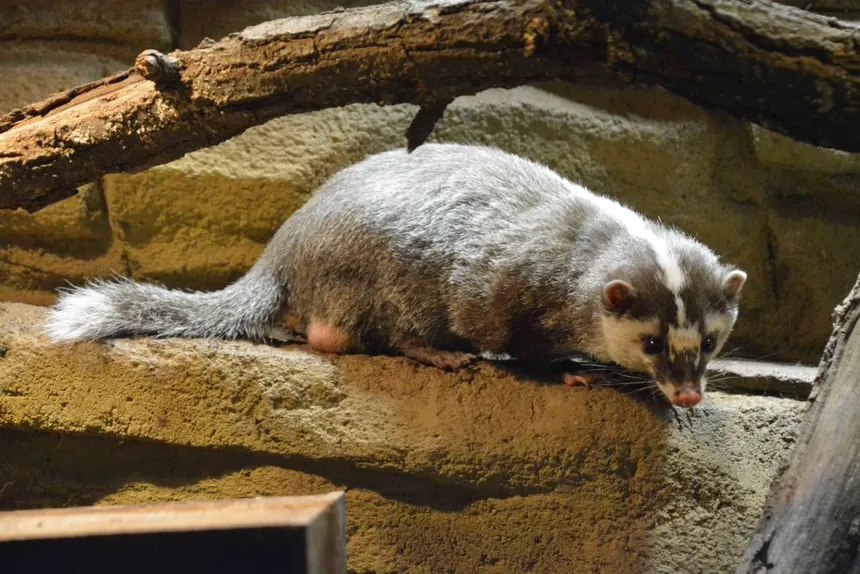
The Javan ferret-badger (Melogale orientalis) is a small, rarely-seen carnivore native to the Indonesian island of Java. This nocturnal creature, belonging to the mustelid family (which includes weasels, otters, and badgers), remains incredibly enigmatic, with a surprisingly limited understanding of its biology and behavior despite being known to science since 1900. Its rarity has led some to suspect it may be facing extinction, though confirming this is difficult given the challenges of studying such a clandestine animal. Physically, it’s a slender badger-like animal, typically around 33-40 cm long with a bushy tail adding another 15-25 cm. Its coloration is predominantly dark brown or black above, contrasting with a paler underside, and a distinctive facial mask adds to its characteristic appearance.
What truly sets the Javan ferret-badger apart is its incredibly limited range and frequent absence from scientific observation. Historically, records were sparse, largely consisting of museum specimens collected in the early 20th century. For decades, the species was considered incredibly rare, and even potentially extinct. A resurgence of sightings, largely thanks to camera trapping efforts in recent years, has confirmed its continued existence, but indicated a highly restricted distribution tied to primary and secondary forests. They seem to prefer areas with dense undergrowth and access to water, foraging amongst leaf litter and potentially exploiting microhabitats within the forest floor. This preference contributes significantly to the difficulty in finding and studying them.
The ferret-badger’s diet remains largely speculative, but based on observations of related species and stomach contents from limited samples, it’s believed to be opportunistic. It likely consumes invertebrates like earthworms and insects, small vertebrates like frogs and rodents, and potentially even fruits and roots. Their elongated bodies and strong claws suggest they are adept at digging, potentially both for prey and for constructing burrows. However, their burrowing habits are poorly understood. Similarly, little is known about their social structure or reproductive behavior. Current understanding suggests solitary habits, though the possibility of breeding pairs or small family groups can't be ruled out.
Despite the renewed sightings, significant threats plague the Javan ferret-badger. Habitat loss due to deforestation for agriculture, logging, and human settlement is arguably the biggest concern. Fragmentation of remaining forest patches isolates populations, hindering gene flow and reducing the species’ resilience. Additionally, they may be hunted, both intentionally for bushmeat and unintentionally as bycatch in snares set for other animals. The lack of widespread awareness about the species contributes to the problem, making conservation efforts particularly challenging.
Protecting the Javan ferret-badger requires a multi-faceted approach. Increased research is crucial to better understand their distribution, population size, and ecological needs. This includes expanding camera trapping programs and potentially utilizing non-invasive genetic sampling. Crucially, conservation efforts must focus on preserving and restoring their forest habitat, working with local communities to promote sustainable land use practices, and tackling the illegal wildlife trade. Without concerted action, this fascinating and elusive creature risks fading into complete obscurity, becoming a true cryptid of the Indonesian rainforest.